Now it looms
the End
Venice as a place of illusions, tensions, ideals. Leaving and arriving.Water versus stone.
It is a city of perpetual conflict.
A constant desire to know, absorb, consume, rationalise, obtain and collect fights an impulse to create, meditate, offload, wander aimlessly, forget and give over to sensation.
No reflections. Meaninglessness brought about by repetition and fatigue. Profundity created by slowly realised associations, and an understanding that only comes with time.
Modernist designs weathered, slowly bending out of function, become objects of art, displayed in a city that constantly restores the ancient. A sense of failed utopia. Failure softened by nostalgia. Romance heightened by gloom and early dusk.
All this with the awareness of leaving so soon, returning to normality.
A last thought... my mind is wandering away on it's own
I wonder if we constantly maintain: appearances, buildings, artworks, to create the illusion of time never passing, of being ever present? What constitutes this importance? Is 'the moment' the only time we touch eternity?
over for now
Friday, 20 November 2009

Saturday, 7 November 2009


Friday, 6 November 2009
art overload
The longer I stay in this City, the more there is that I haven't seen it seems.
There is art pouring out of every available space, some of it still manages to be good. I went to the Giardini for the first time, where all the national pavilions are. It's like a big fun fair for contemporary art. Massive tour groups clamour at the buildings' doors to get a peek and a photo.
There is art pouring out of every available space, some of it still manages to be good. I went to the Giardini for the first time, where all the national pavilions are. It's like a big fun fair for contemporary art. Massive tour groups clamour at the buildings' doors to get a peek and a photo.
There were a few amazing pieces, like Fiona Tan's video installations, Simon Starling's elaborate film display machine, the Nordic and Danish pavilions' menacing houses, Steve McQueen's long slow film, the Australian performance videos and Yoko Ono's text works. Here are some photos from my epic marathon of art viewing.


Hello Venice
I've been busy. Scratching the surface of the Venetian façade.
Migropolis a searching, feeling revelation of the city's underside. Investigating lives, deaths, trade agreements, illegal immigration and movements of peoples across Africa, Asia, and through the "gateway to Europe"It is an interesting and unoriginal observation that Venice is a city of false appearances. The palazzos facing the grand canal have their masks on, hiding structures, wooden beams, crumbling plaster. Piazzas and waterways are full of colour, byzantine, baroque, gothic, romantic, and gondolas idle around like the props of a city sized theatre.
I'm scared now, this is a city full of ghosts, but they are not the ones we all imagine, Casanova, Titian, Marco Polo, a hundred murdered Doges... they are ghosts, Senegalese, Bangladeshi, Albanian, of those whose boats capsized in the adriatic, and hung from prison roof beams at the prospect of deportation.
It's depressing so it's avoided, and theme park Venice captivates us again.

Wednesday, 28 October 2009
Lithuania, Iran and Scarpa

just popped into the Lithuanian pavilion today... wooooo
video tape madness :)
also got a bottle of procecco from the invigilator... what a life eh?!
this one is 'tube' by Zilvinas Kempinas.
trippy ol video
yesterday I done went to the Iranian exhibition on one of my hours off, it was really simple, but also really pure somehow... I loved the colours. some time I'm going to have to make an intelligent contribution to this blog... but right now just lapping up the art .. yeah .. ?
here's a photo of one of the Iranian paintings, by Sedaghat Jabbari:

also.. went to the Scarpa museum at s. maria fermosa, which I unfortunately couldn't photograph. I'll see if I can nick one off the web ... here we go:
It was very delicate and peaceful... and brilliant in his use of water and the flooding canal.

Tuesday, 27 October 2009
venice love
 lovely art
 el fincho a la arsenale
 löwen guarding the arsenale
 face
 show from Georgia (change in drawing orchestra by Koka Ramishvili)
great space and interesting video installation, really liked the sounds
 one of my favourite works so far, Paul Ramirez Jonas (Luna De Papel) encourages the audience to participate by reading a section of the moon... reminds me of Steve McCaffery's action poems (see march 09 entry on INSTAL festival) there is a much better photograph here: photo
 I really enjoyed the tongue in cheek signage to the UEA pavilion, I think it was really the main point of their show...
 a spiffing bit of engineering at the arsenale
 Tamara Grcic's installation at the arsenale. Really beautiful yesterday in the wintery sun.
 rude art
 Rick & Rude ART
 fun art by William Forsythe

 sign at the arsenale
 team gb's day out

 enough art for today... Sunset over Venice
Friday, 23 October 2009
some venice days
 tiny musical instruments at the museum in San Lazzaro degli Armeni Սուրբ Ղազարոս Կղզի
 the grand canal from academia bridge
 Jess and Fergus at San Lazzaro degli Armeni
 Jess
Sunday, 18 October 2009
some snapshots of venice
so I've lost me camera, so these are all taken on my shoddy wee phone camera
some of my favourite pieces at the arsenale:
 (Chile) Ivan Navarro death row
 (Chile) Ivan Navarro
 Grazia Toderi orbite rosse
 Spencer Finch moonlight and Huang Yong Ping Buddha's Hand
 Spencer Finch big bang (mars black) and Haung Yong Ping Buddha's Hand
some of my favourite pieces at the arsenale:
 (Chile) Ivan Navarro death row
 (Chile) Ivan Navarro
 Grazia Toderi orbite rosse
 Spencer Finch moonlight and Huang Yong Ping Buddha's Hand
 Spencer Finch big bang (mars black) and Haung Yong Ping Buddha's Hand
Thursday, 15 October 2009
today
It's very cold here in Venice, we've closed the gallery windows because the icy air blasting through them makes us feel like our limbs have turned to stone.
The palazzo feels more like an interior now though, something contained, whereas before it felt, like the artist described, a bit like a landscape blown through a building. The icy wind somehow continued this, scraping the waxy leaves eerily across the floor and carrying the voices from the street into the rooms around us.
I can't sit here and freeze though.
A blind lady came into the exhibition today, she had dark glasses on to cover her milky eyes, and her sister walked close by her, leading her across the uneven stones. I have to admit this frightened me more than it should have, but Venice has been acting up lately, thick fog and creaking whispering voices drift down the canals at night. It would hardly surprise me if I caught a glimpse of a little red coat, disappearing into a dark passageway, luring me to my untimely demise.

Sunday, 11 October 2009
Biennale
 "No Reflections"
this week I've been finding it difficult to think about the work,
last week was easier, the wondering was still part of the job.
Martin Boyce's work requires time, a sense of abandonment heightened by the weird acoustics of the location, Venice's echo soundscape tricks you into thinking the voices you hear are actually there, in the room. But they are distant, below. Venetians walking to work, a gondolier singing to his fabulously wealthy customers, a German tour group fifty tapping feet on the bridges nearby. Every weekday at noon the school children's voices drift up to the exhibition, ghost children playing in a forgotten playground. There is a crimson sculpture here that reminds me of a little ghost child from a 1970's horror film who I'd rather forget walking home through the whispering city at night.
The water is rising in Venice. Soon the acqua alta will drench the ground floors of the city's shops and houses and the tourists will be forced to teeter along wooden walkways strewn across Piazza San Marco, a labyrinth within a labyrinth. The mists roll in from the Adriatic, drenching everything in a heaviness.
A long time ago the acqua alta flooded the 4th floor of a 15th century palazzo. Stepping-stones were placed across the main hallway so people could walk across from one room to another. Birds came to drink and bathe in the shimmering pools, and trees grew, downwards from the ceilings, reaching towards the water. Now the water has gone the stones are left as if suspended. The trees are dead, petrified like the trees supporting the city below, poking into the lagoon. No brilliantly coloured birds rest and flutter, the pools have dried up, and the nesting box built for them lies empty. The level of the water is marked in rust on the metal objects left behind, like the carvings on the walls in Venice, a testament to disaster, change, a sinking city.
Tuesday, 8 September 2009
frozen river
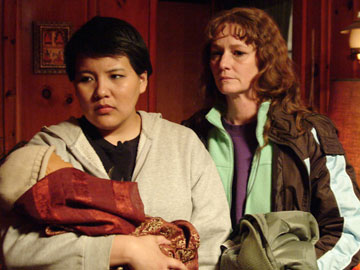
went to see Courtney Hunt's frozen river last night.
It's so great to see so many good films by women lately, like Red Road n that. yeah?
I thought the acting was good and camera work distracting at first then better. hmm yeah films? yeah?
Monday, 31 August 2009
updates
so it been a while again due to lack of degree (forced creativity) and lack of internet
however, it would be good to resume...
currently inspired by:

walk cycles by Eadweard Muybridge
however, it would be good to resume...
currently inspired by:


walk cycles by Eadweard Muybridge
Wednesday, 17 June 2009
Sunday, 3 May 2009
Video/Idéa/Vison
An interesting excerpt from a book I'm reading at the moment:
The Indo-Europeans sought "insight" into the history of the world, we can even trace a particular word for "insight" or "knowledge" from one culture to another all over the Indo-European world. In Sanskrit it is vidya. The word is identical to the Greek word idéa, which was so important to Plato's philosophy. From Latin, we have the word video, but on Roman ground the word simly means "to see". For us "I see" can mean "I understand" and in cartoons, a light bulb can flash above Woody Woodpecker's head when he gets a bright idea. (Not until our own day did 'seeing' become synonymous with staring at the TV screen). In English we know the words 'wise' and 'wisdom' - in German 'wissen' (to know'. Norwegian has the word 'viten', which has the same root as the Indian word vidya, the Greek idéa and the Latin video.
All in all we can establish that sight was the most important of the senses for Indo-Europeans. The literature of Indians, Greeks, Persians and Teutons alike was charachterised by great cosmic visions (there is that word again: "vision" comes from the Latin word video). It was also characteristic for Indo-European culture to make pictures and sculptures of the gods and mythical events.
Sophie's World by Jostein Gaarder, page 127

Thursday, 30 April 2009
wearing thin
Posts are a little thin on the ground these days as I move towards full time production and less research. It's less than 2 weeks until the assessment!
I will put some interesting things up when I have time though.
I will put some interesting things up when I have time though.
Wednesday, 15 April 2009


hello

not a single entry in april! I'm shocked!
maybe there's a degree show coming up or something...
here's some things I've been doing:

Tuesday, 31 March 2009
The Class
I was recommended to go and see The Class (Entre les murs) (enter the walls?). Directed by Laurent Cantet and written by François Bégaudeau who plays a version of himself in a tough Paris school. The film manages to captivate despite most of it taking place in one classroom, with mostly the same camera angles. The dialogue is quick and hard to follow for the most part, with the colloquial French and heated conversations clumsily translated at points. However the film remains compelling and I felt willing to put the necessary work into following the loosely constructed narrative.
Part of what makes it so compelling is the fact that the actors are all untrained, and for the most part playing themselves. There is no indication of this, apart from the fact that they are completely convincing, portraying themselves/their characters with a startling integrity.
I really want to know what François Bégaudeau wanted to achieve with making this film... was he making it for the class? there seems to be a slight air of self righteousness in the portrayal of his character in staff meetings, he is the one sticking up for the trouble makers, trying to convince his colleagues that each pupil needs individual treatment and that punishment often doesn't work. When an ugly incident crops up - he calls two of his pupils skanks, resulting in a display of insolence and violence from one of the most volatile pupils - we feel almost ready to forgive him, due to his constant defense of the pupils in the staff room. I wonder if he really felt the need to somehow redeem himself to the pupils who only saw one side of his character by making a film which portrayed a different reality.
A wonderful part of the film comes right at the end when the ever cheeky, often insolent and apparently ignorant Esmeralda reveals that she read Plato's Republic over the school year. This throws the whole film into a different perspective, as we recognised François' teaching method mirrored in the character of Socrates, provoking a democratic way of thinking and asking awkward questions, encouraging active participation from all his pupils, even if it sometimes descends into a rabble. Sometimes it becomes unclear who really has the ultimate authority.
http://www.hautetcourt.com/fiche.php?pkfilms=142
Subscribe to:
Posts (Atom)


